Saturday, January 14, 2023

These are (Not Necessarily) the Best Films of 2022


Yes, you read that headline correctly. 

I make no claims that what follows are the absolutely very best films of the year just ended. And here's why... 

As the title of this blog says, I am a PART TIME cinephile, not a full-time professional film critic. I saw exactly 97 of the films released  in 2022, less than half of what a professional critic would see. But I am an enthusiastic, highly selective amateur critic; I focus on seeing as many of the best films as I can squeeze into a schedule that allows for other passions and pastimes. Even so, I miss a sizable number of each year's releases. Here's an overview of what I didn't see (or, in some cases, started but didn't finish).

The Ones That Triggered my Sensory Issues: When I launched this blog seven years ago, I outlined some of my limitations as a reviewer, advising my readers that "I don't do action/adventure/superhero flicks; they overstimulate my nervous system and make me anxious." And actually, it goes beyond that. Films of any genre that are loud, hectic, loaded with quick-cut editing and non-stop frantic movement are anxiety-producing for me as well. You can safely assume that I am not a Baz Luhrmann fan for just that reason.

In the intervening years, I've been able to relax enough to get through a couple of Avengers movies, both Wonder Woman films, several entries in the Thor franchise and a few other action flicks. But I lost some ground during the cosseted years of the Coronavirus lockdown. Forty-five minutes of the amped up action scenes and wildly exuberant dance numbers in RRR were all I could manage out of its over-three-hour running length, then I bailed.  I did manage to get all the way through Everything Everywhere All At Once and Elvis, but in both cases, I was overwhelmed and exhausted by the time the end credits rolled. So you won't see any of these on my list,.because I can't give them a fair evaluation.

The Other Ones I Couldn't Finish: The Menu, White Noise, The Northman, Bardo: A False Chronicle..., You Won't Be Alone 

The Ones I Just Didn't Get To: Jurassic World Dominion, The Batman, Bones and All (I don't do cannibal movies), Avatar: The Way of Water (I still need to see the first film); The Woman King; The Lost City; Babylon, The Whale (but I'm seeing it tomorrow!), Till, The Inspection, The Outfit, Black Panther: Wakanda Forever, Kimi.

Limited or Missed Opportunities: Aftersun, EO, All the Beauty and the Bloodshed.

One other qualification for this list: the film must have been released for the first time in the Chicago area between 1/1/2022 and 12/31/2022 inclusive, whether in a theater or via home streaming. (Film festival screenings prior to the general release date do not count). That's why you'll see at least one movie on this list that is generally considered to be a 2021 film. And that's also why you won't see any of the following films here, although they'll be eligible for consideration in 2023: Corsage, Saint Omer, BrokerThe Quiet Girl, No Bears, Women Talking, Living, Holy SpiderA Man Called Otto.

Even with ALL those qualifications and omissions, I came up with a list of 12 exceptional films that I had to honor, and a healthy list of Honorable Mentions as well. If there's a 2022 film you don't see mentioned anywhere in this post, you can probably assume I saw it and didn't like it that much.

Here are my favorite films of 2022,in reverse order of preference. ("Where to stream" information is included for each film; where I've referenced "the usual platforms," those are Amazon, Apple, Google Play, Redbox and Vudu):

12. Stars at Noon (director: Claire Denis)

Claire Denis' best films aren't so much stories as they are visual tone poems. There may be a narrative, of sorts, but Denis is more focused on creating moods and conjuring emotions. If you can surrender to the vibe and ride it like a wave, you'll love her work. I certainly do. 

Margaret Qualley plays a American journalist who's hit the skids in Nicaragua. She can't get work, nor can she get out of the country, so she's reduced to prostitution to keep going. After falling into a torrid affair with a shady English businessman (Joe Alywn), her situation gets more dire and the trade-offs she makes to get home get ever more compromising. It's not a conventionally suspenseful film, but the urgency of Qualley's situation evolves in a subtle but devastating fashion. And Qualley, an exceptional young actress, carries us through it with seamless assurance.

Stars at Noon is available to stream on Hulu with a subscription or to rent from the usual platforms.

11. The Fablemans (director: Steven Spielberg)


Spielberg looks back on his own childhood, his filmmaking origins and his parents' troubled marriage with love and forgiveness, plus a little bit of palpable pain. The film is every bit as luminous and entertaining as one would expect, and Spielberg elucidates the childlike sense of wonder that has informed some of his best work.  There are clues to the origins of  Spielberg's pet themes and formative influences as well. Michelle Williams has received entirely deserved praise for her role as the free-spirited, volatile mother; her effectively mannered performance is nicely balanced by those of Paul Dano as her husband and Seth Rogen as a close family friend.  It's also wonderful to see the great Jeannie Berlin in a small role based on Spielberg's grandmother.
 
The Fablemans is in theaters or available to rent from Apple or Amazon at a premium price ($19.99)

10. She Said (director: Maria Schrader)


An expertly constructed, true-life journalistic thriller, in the manner of All the President's MenSpotlight and The Post  but with a uniquely female perspective. Here we follow New York Times reporters Jodi Kantor (Zoe Kazan) and Meg Twohey (Carey Mulligan) as they work to expose Harvey Weinstein's history of sexual predation and abuse. On one level, it follows the playbook for investigative reporting stories - lots of tracking down reluctant witnesses, newsroom discussions with editors and so on - but here the reporters are also dealing with issues like postpartum depression and juggling child care and family obligations.  The suspenseful thrill is still there, as is the reporters' relentless dedication to break an important story, but it doesn't skim over the personal challenges they handle along the way.

She Said doesn't seem like the kind of film you have to see in a theater, but I'm glad I did. At the multiplex screening I attended, the almost exclusively female audience burst into sustained applause at two critical points in the story when it was obvious that shit had gotten real for Mr. Weinstein.  I can't pretend that audience reaction didn't influence my decision to put She Said on my year's best list; it's the greatest affirmation I can point to for the film's power and impact.

She Said is available to stream only on Peacock with a subscription. 

9.After Yang (director: Kogonada)


I first watched After Yang on a flight to Lima, on a tiny screen while wedged into a cramped economy class seat. And even in that far less-than-ideal setting, I found it incredibly moving. 

In the future world where After Yang is set, there something called a 'techno-sapiens,' a sort of convincingly human- like android that can be purchased for use as a household helper. One such android, Yang, is a sort of babysitter to Mika, the adopted daughter of his owners, and is treated much like a member of the family. But Yang is a 'refurbished' techno-sapiens, purchased secondhand by the the girl’s father (Colin Farrell), and one day he simply breaks and stops functioning. So Farrell goes in search of the parts to repair Yang and, in the process, comes into possession of Yang's "memory box." In that box are stored images and short recordings of people and moments that Yang considered important to preserve.

It's the contents of the memory box, and what Farrell learns as he searches for the people and places he sees there that give this film its lovely, grieving heart. (There are many scenes from Yang's life with a previous owner, including his relationship with a young woman played by the always wonderful Haley Lu Richardson.) Seeing what Yang sees - what touches and fascinates him - only intensifies Farrell's appreciation of beauty and relationships with loved ones. The film is filled with soft, burnished colors and infused with a sustained sense of melancholy. It's comforting to watch and challenging to ponder, all in the same moment.

After Yang is available to stream on Showtime with a subscription or to rent from the usual platforms.

8. Emily the Criminal (director: John Patton Ford)


Here's what I wrote after seeing this film back in October. It's all still true, and after watching the film again recently, I have an even deeper admiration for Aubrey Plaza's performance in the title role:

"A great performance from Aubrey Plaza makes this film an especially compelling experience. Plaza plays a restaurant delivery worker who's struggling - and failing - to pay off student loans while making the rent. Given the opportunity to make fast cash as part a credit card fraud ring, she's at first hesitant, then all in. Emily the Criminal subverts expectations; at first glance, it appears to be an almost Ken Loach-esque tale about the impossibility of getting by in the gig economy, but it evolves into something darker and more particular. Plaza's Emily is a complex and not altogether sympathetic character. At some point, it becomes difficult to tell which characters are criminals and which are victims."

Emily the Criminal is available to stream on Netflix with a subscription, or to rent from the usual platforms.

7. Top Gun Maverick (director: Joseph Kosinksi)

Because it was just so much fun, hit all the right emotional notes and got us all back into movie theaters again. What other reasons do I need, really?

The scenes of fighter pilots slicing through the air are every bit as thrilling and exciting as you'd expect, more so than in the original thanks to the improved technology of the intervening 36 (!) years. Tom Cruise's Maverick got his redemption story. Goose's son (Miles Teller) turned out to be a chip off the old block. They even worked Val Kilmer's Ace into the story, lightly skirting around the actor's now badly ravaged voice (the result of throat cancer) to give the character an emotionally charged farewell.

It is - dare I say this? - better than the original Top Gun.

Top Gun Maverick is available to stream on Paramount Plus with a subscription or to rent on the usual platforms.

6.The Eternal Daughter (director: Joanna Hogg) & 5. Turning Red (directo: Domee Shi)

Two very different films explore the complexities of mother-daughter relationships from different but equally compelling perspectives.

The Eternal Daughter is the less accessible, more eccentric of these two films, but it has an eerie vibe that grows on you. Director Joanna Hogg returns to the autobiographical character of Julie Hart, whom she introduced in The Souvenir, now middle-aged and played by Tilda Swinton. As part of her preparation to make a film about her mother's life, Julie takes her to a Welsh guest house for a week to talk with her about her memories of living there as a child during World War II. 

In an inspired bit of double casting, Julie's mother is also played by Swinton. It's a skillful set of performances by the actress, subtly etching in the details and sore spots in their relationship as Julie probes her mother's childhood memories.

But something is amiss here. The desk clerk alludes to other guests in the hotel, but we never see them. Winds howl, things go bump in the night. The Eternal Daughter initially plays like a ghost story, but it evolves into something entirely different with a startling twist in the final chapter that will make you go back and watch the whole thing again to look for clues. 

At the other end of the spectrum, there's Turning Red, an exuberant Pixar animation that perfectly captures the emotional highs and lows of that delicate moment when girls morph from children into hormonal adolescents - and the resulting impact on their relationships with their mothers. (Yes, that's a lot for a cartoon, but since when have Pixar films ever been mere cartoons?) Set in Toronto's Chinatown in 2002, it's rooted in a specific culture and speaks thoughtfully to the dilemma of a immigrant's child struggling to reconcile her commitment to family tradition with her desire to embrace the culture of their adopted home. Yet it also hits on universal truths about how girls relate to their mothers and whether we live out our parents dreams for us or follow our own lights.

Meilin (voiced by Rosalie Chiang) is a feisty, enthusiastic eighth grader (a "very enterprising, mildly annoying young lady" according to her teachers, an "overachieving dork" per her classmates). She's torn between her mother's expectations (straight As, helping the family with the tourist-friendly temple they operate) and her big love for her friends and a dreamy boy band called 4*Town. 

The film's title, coupled with the subject matter, unavoidably evokes the onset of menstruation; the filmmakers acknowledge this and winkingly play with it. After Meilin freaks out and locks herself in the bathroom, her mother (Sandra Oh) comes running with a box of pads and knocks on the door to gently inquire, "Has the red peony bloomed?" It has not; it's considerably more complicated than that. In a moment of intense anger and embarrassment,  Meilin has turned into a giant red panda.  It's a condition shared by all the women in her family, albeit one they have learned to tame and contain, mainly by avoiding intense emotion. But Meilin grows to enjoy the experience of being that irrepressible panda. Adolescent rebellion ensues, as does maternal panic. But  all gets sorted out in Pixar's reliably authentic-yet-uplifting fashion.

The Eternal Daughter is available to rent from the usual platforms. Turning Red is available to stream on Disney Plus with a subscription or to rent from Amazon.

4. The Wonder (director: Sebastian Lelio)

I'll be honest, I don't know if The Wonder would even be on this list were it not for Florence Pugh's performance. She's in virtually every frame of the film, and she is consistently mesmerizing. The very first scene is just Pugh thoughtfully eating a bowl of soup, and she makes even that most mundane of actions fascinating to watch.

Pugh plays an English nurse dispatched to Ireland in the 1840s to observe a young girl who has not eaten for months but continues to live and be healthy. The townspeople are inclined to see this as a divine miracle; Pugh's no-nonsense nurse is not convinced. The story evolves gradually and devastatingly as the layers of truth in the situation are peeled back. Pugh's character is a sort of stand-in for us, the audience; her skepticism and her diligent search for the truth keeps the narrative moving forward.  She's the outsider looking into a entirely different culture. Let me remind you that the English were none too popular with the Irish at this time (or probably at any time); At times it almost seems that Pugh's character was invited there only to be refuted. Or possibly converted.

Director Sebastian Lelio bookends the film with scenes of the soundstages where it was shot. A narrator reminds us that we are about to see is a story and that every character in it has a story that they believe in fully. Even though that turns out to be true, it's a slightly awkward framing. Yet the moment the camera first sweeps in to show us Pugh eating that soup, we are completely and convincingly transported to the 1840s and drawn into the events of the narrative. It’s a transition that, in the wink of an eye, demonstrates the transformative magic of movies.

The Wonder is available to stream only on Netflix with a subscription.

3. The Worst Person in the World  (director: Joachim Trier)

I first saw this at the 2021 Chicago International Film Festival, at which time I wrote:

"This Norwegian comedy-drama about a thirty-something woman's inability to settle on a career path or a partner is a pleasant, if not spectacular, way to spend a couple of hours.  It's been compared by at least one critic to Frances Ha  - an apt comparison, although this film is more distinctly European in its ambiguity. Its scenes wander in and around the characters emotions, without clearly defined comic beats or other cues to elicit desired audience reactions.

The film benefits from the fine lead performance of Renate Reinsve, a sweet-faced and subtle actress who comes off as likable and sympathetic even as her character makes selfish, ill-advised life choices. Her drift from job to job is played for laughs, while the scenes of her romantic break-ups are played with a realistic ambivalence and genuine pain.

I've seen a few films by this director (Joachim Trier), but I think this may be my favorite of his work. It's certainly the sunniest and sweetest of his films that I've seen."

A repeat viewing this year only deepened my appreciation. There's  a sweetness and a joy to this film, as well as a clear-eyed look at how we all grow past and out of romantic relationships, but without anger or resentment towards those we leave behind. 

The Worst Person in the World is available to stream on Hulu with a subscription or to rent from the usual platforms.

2. The Banshees of Inisherin (director: Martin McDonagh)
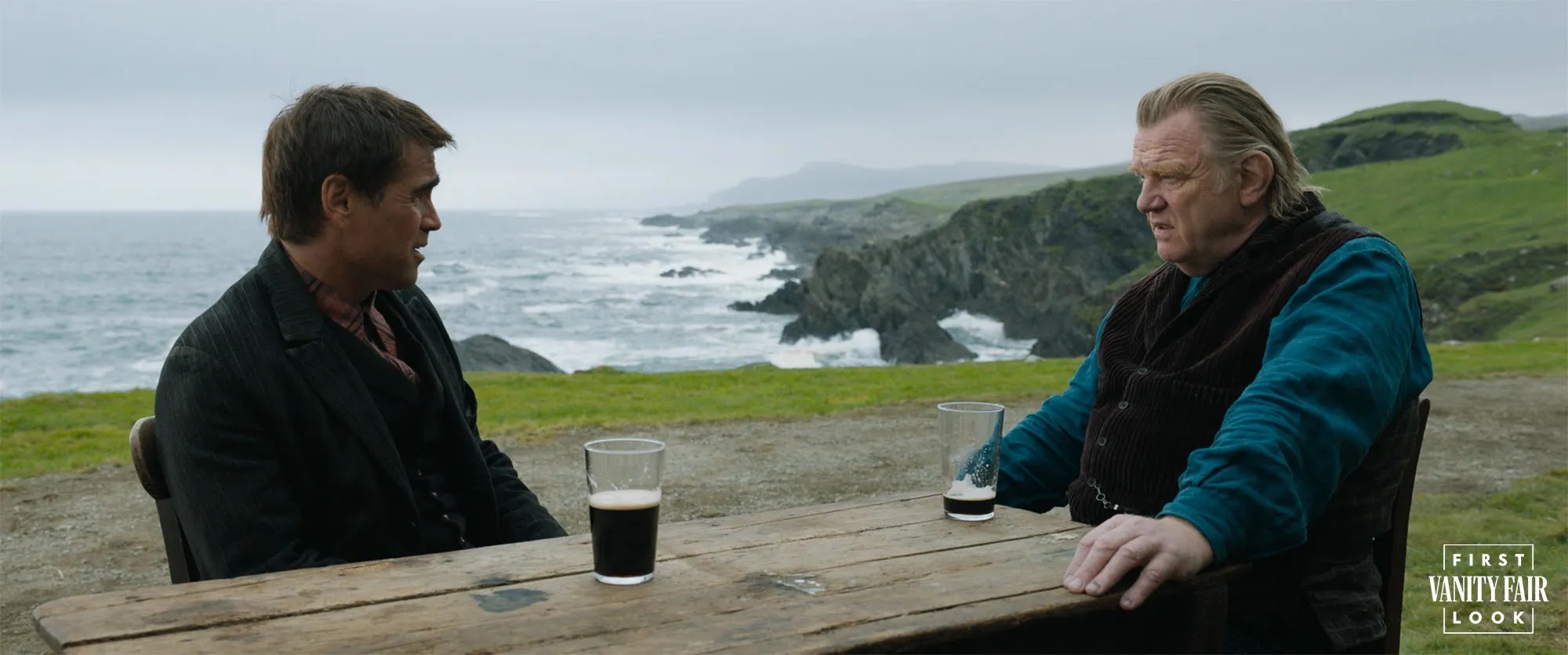

The setting is an island off the coast of Ireland, and the time is 1923. The low roar of gunfire can be heard from the mainland where a civil war is raging. But on the isle of Inisherin, the squabbles are far less consequential if, in their own way, nearly as brutal.

After years of sharing daily chats and pints in the pub, Colm (Brendan Gleeson) decides he can no longer be friends with Padraic (Colin Farrell) because he finds Padraic dull company. Colm dreams of writing music and making something meaningful of his remaining days, while Padraic, confused and hurt, keeps chipping away at Colm for rapprochement. Colm becomes so indignant that he threatens to cut off his own fingers, one by one, if Padraic doesn't leave him alone.

If you've seen any other of Martin McDonagh's films, you can probably guess where this is going. 

I hated McDonagh's last film, the dreadfully overrated Three Billboards Outside Ebbing Missouri, but this film has redeemed him in my eyes. Back in his own native Ireland, McDonagh is on surer ground. His dark, deadpan humor works brilliantly here, particularly as acted by Farrell and Gleeson, as brilliant a double act as we've seen onscreen in many years.  There's lots of fine work by the supporting cast as well (including Kerry Condon as Farrell's sister and Barry Keoghan as a lonely misfit who harbors an unrequited love for her.) The film is suffused with an underlying sadness and sense of loneliness, even in its most ridiculous moments. It's a tale of small things - petty grievances, idle gossip, fleeting moments of contentment - but it accords to those small things a deep emotional resonance.

The Banshees of Inisherin is available to stream on HBO Max with a subscription or to rent from the usual platforms.

1. TAR (director :Todd Field)

I wrote at length about TAR back in October: you can read the whole review here.

Since then, I've rewatched this film twice, and it only gets better and more impressive on repeat viewings. With another look, I could better appreciate the subtle accumulation of thoughtfully chosen details that reveal who the characters are and what they're about.  And I gained even stronger  admiration for Nina Hoss' portrayal of Tar's wife, Sharon. Hoss is the master of understated but telling alterations in facial expression; the whole history of her relationship with Lydia is etched in every watchful glance, every raised eyebrow. It's the kind of quiet but devastating performance that unfairly gets overlooked at awards time. But you can be absolutely sure that Blanchett will be scooping up another armload of trophies this season; she's already nabbed a Golden Globe and several critics' awards.

TAR is available to rent from the usual platforms.

Honorable Mention: Armageddon TimeBenediction, Brian and Charles, Decision to Leave, Fire of Love, Good Luck to You Leo Grande, Lost Illusions, Marcel the Shell With Shoes On, Sundown.

2022 Nominees to the Academy of the Overrated: Triangle of Sadness, Crimes of the Future

Friday, January 6, 2023

(Not the) Best and Worst of Streaming Series, July-December 2022


This is the first in a series of posts looking back at film and television in 2022.

Remember those glorious days of old when you could count the number of existing television networks on one hand, and premium cable was limited to HBO, Showtime and Cinemax? How quaint and long ago those days now seem... and how much easier it was then for one person to compile an authoritative list of the best series of the year. 

With the explosive proliferation of streaming channels and series nowadays, it's impossible for me to watch it all and supremely challenging to get to even a significant percentage of it. I can't honestly do much but pass on my recommendations and admonitions regarding the small subset of programs I actually managed to watch. 

Not that I don't make an effort. I've already published my thoughts about a number of streaming series that aired in the first half of 2022. (You can read them here.) What follows are my thoughts about programs that have aired since July 1. 

One other thing..

If there's an overriding theme here, it's that almost all the really good shows aired in the first half of the year. It was slim picking's from July on, but I did my best...

A Little Better than Expected: Welcome to Chippendale's (Hulu)

I fully expected a series about the infamous male strip club franchise to be good, campy fun and not much else. And  Welcome to Chippendale's does intermittently provide that kind of bawdy amusement. But there's a bit more, including a 'true crime' element of which I was completely ignorant when coming to the series.

Kumail Nanjiani turns in a stellar performance as Steve Banerjee, the Indian immigrant who went from managing a small gas station to owning the Chippendale's franchise to arranging the murder of his business partner. Nanjiami has described the visual image that guided his portrayal as "a block of ice with a tiny flame inside it," and he impressively plays to that idea. His Banerjee is a buttoned-up, calculating, humorless pillar of repressed rage, sensitive to the slights and prejudice he endures as a brown-skinned man in America but all too ready to inflict the same slights on black employees and customers he believes will make Chippendales "less classy" in the eyes of his predominantly white clientele. 

Murray Bartlett's hilarious, irrepressible performance as Nick DeNoia (the club-choreographer-turned-face-of-Chippendale's) is the perfect foil to Nanjiani's grumpy number-cruncher. The "Dr. Hunkenstein" production number his character stages is just about Broadway-worthy. Anna Leigh Ashford, Juliette Lewis, Andrew Rannells, Robin De Jesus and Quentin Plair round out an excellent cast of supporting players.

But despite that cast, Welcome to Chippendales ultimately offers little more in the way of story or revelations that you could find in a television documentary on the subject - and most of those are on Hulu, too. In fact, you might want to skip the series finale altogether and just Google the details of Banerjee's downfall. That is, unless you'd really rather watch the hokey scene where Banerjee is visited in prison by the Jacob Marley-esque ghost of his dead colleague.

Less Bad Than I Expected: Harry and Meghan (Netflix)


Yes I watched all six hours. And yes, I cringed and rolled my eyes more that a few times.

Unfortunately I can't un-see these two doing their affirming guided meditation together, their eyes shut and brows photogenically furrowed as they remind themselves that all the negativity coming at them isn't about who they really are,. (For the record, I have nothing against self-affirming guided meditations - I've done them myself to great personal benefit. But nothing on heaven or earth would induce me to film myself in the act and then put it on Netflix.)

Then there is the scene where Meghan demonstrates the exaggerated, bizarrely theatrical curtsy she made to the Queen on their first meeting. Even Harry looks embarrassed. And that's before we get a glimpse of the fabulous California mansion that Tyler Perry loaned them. 

But here's the most important takeaway: this series makes some legitimate, well-documented, and extremely damning claims of racism against both the British press AND the monarchy. The media references to Harry's "gangsta" girlfriend who's "almost straight out of Compton" are only the tip of the iceberg. There's a segment in which news stories about the former Duchesses of Cambridge and Sussex are shown side by side.  Where Kate is praised and celebrated for certain innocuous behaviors (eating avocados while pregnant, fondling her baby bump in public), Meghan is mocked and excoriated for doing exactly the same things! "If  you can't see the racism... then I can't help you," Harry tells us. He's absolutely right.

When Meghan's naivete and over-earnestness morph into entitled whining, it's tempting to tune her out entirely. But in other moments she speaks convincingly uncomfortable truths about the coldness and prejudices of the British ruling class and its many slavishly sycophantic enablers.  Harry's late mother did virtually the same thing in her time, and we effectively beatified her for that. But she was an aristocratic white woman. When an American woman of color speaks out, it's a whole different ballgame. 

Sophomore Slump: Only Murders in the Building (Hulu); 


You know what depresses me the most about writing this entry? It's that I can still remember specific details, lines and scenes from this show's first season (and with great pleasure, I might add), while all I can recall of the second season is that it was a convoluted muddle of new characters and plot complications, including some kerfuffle about whether Martin Short's son was really his son.  Also there was a guest appearance by Shirley MacLaine. It gives me no pleasure to report that the sophomore season of Only Murders in the Building was entirely too much of a formerly good thing; however I have high hopes for the third season as teased in the final episode. Paul Rudd is joining the cast! That can't not be a good thing.

Fifth-season Fumble, Part 1: The Handmaid's Tale (Hulu)


I'm so freaking tired of seeing Elizabeth Moss make this face...

A little refresher: The Handmaid's Tale is based on a Margaret Atwood novel. The first season, which debuted in 2017, covered that novel in its entirety, and if they'd ended the series there, it would be forever remembered as a classic. But the intervening seasons have been made up from scratch in a room full of television writers who tend to fall back on torture porn or scenes of visually stunning, Nazi-esque public ceremonies when they can't come up with a plausible plot development. The show definitively jumped the shark in Season 3, right around the time that Atwood published her acclaimed sequel, The Testaments. By the end of season 4, with June's escape to Canada and the cathartic murder of Commander Waterford by a gang of former handmaids, we seemed to be back on track. And this season started strong enough, but then...

While it's been satisfying to see Serena reduced to handmaid status in the household of a Gilead-loving Canadian couple, this season has mostly been just another exhausting round of repeated physical and emotional torture for its major players. (With lots more opportunities for Elizabeth Moss to make her Righteous Fury Face; see above.) I still don't know whether Bradley Whitford's Commander Lawrence is an evil man, a savior, or just a straight-up lunatic; whichever is the case, his crazy-ass line readings are the highlights of every episode.  I'm thankful that next season will be the last, and that the story is finally transitioning towards the plot  of The Testaments (to which Hulu also bought the rights). But Season 6 has a long way to go to redeem itself and take us out on a hopeful note.
Fifth-season Fumble, Part 2: The Crown (Netflix)

After four spectacular seasons, The Crown has hit a bump in the road.

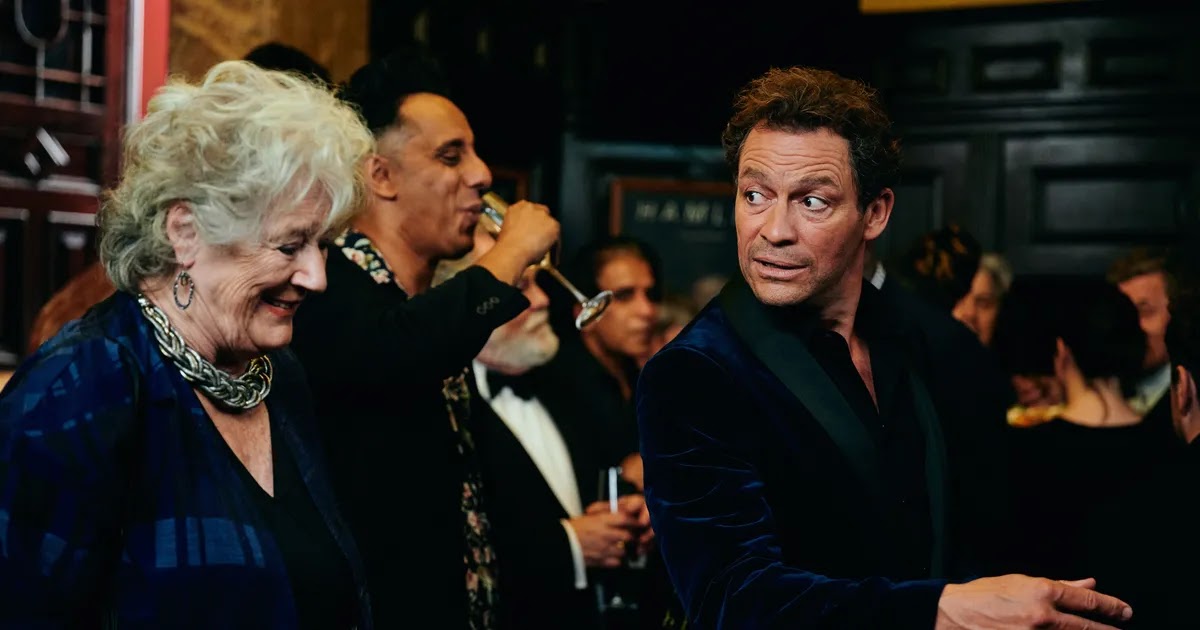
That's partly due to the extreme overfamiliarity of its story lines around Charles and Diana. That icky phone call where Charles told Camilla he'd like to be her tampon takes up about half of one episode. Or Diana's infamous interview with Martin Bashir, which effectively ended her marriage and ensured her exile from the royal family - that's another whole episode. We've seen it all before (repeatedly, in near-nauseating detail) and there's precious little in the way of new insight or thoughtful re-interpretation to be found here. Dominic West neither looks nor sounds like Charles, although Elizabeth Debicki gives last season's Emma Corrin very strong competition for Best Ever Impersonation of  Princess Diana. Like Corrin, both her physical resemblance to the late princess and her meticulous recreation of Diana's mannerisms are uncanny.

But the worst thing that could have happened to The Crown was the death of Elizabeth II, just weeks before the new season debuted. By unfortunate coincidence, Season 5 is all about the scandal-ridden decline of the monarchy in the mid 1990s and carries with it an elegiac sense of  glory days passing into oblivion.  It all too neatly parallels with the current day feeling that the end of Elizabeth's reign  signals a similar passing away of glory. The son who ascended to the throne at her death is far less beloved, thought to be whiny, self-centered and out of touch by many Britons. Not to mention there's been a fresh round of family scandals with Harry and Meghan's departure, plus Andrew's disgraceful connection to Jeffrey Epstein. With Elizabeth gone, the events of  The Crown - even those that don't directly involve Charles or Diana - feel like very old, entirely irrelevant news.

Nevertheless, Peter Morgan  dutifully trots out a new set of metaphors for monarchical decline, finally eschewing his overreliance on dying stags as symbols for doomed royals. They've been replaced by both the disintegrating royal yacht Britannia (whose repairs will not be paid for by British taxpayers, the Prime Minister insists) and the ancient, unfixable television in Buckingham Palace. "Even the televisions are metaphors," the Queen actually says out loud at one point, apparently for the ten or so viewers who haven't already figured that out.

The production values, of course, remain high, and the acting is predictably impeccable. This season gives us no less than Imelda Staunton, Jonathan Pryce and Leslie Manville in the cast, plus the aforementioned West and Debicki. (Not to be forgotten: Johnny Lee Miller's John Major and Olivia Williams' Camilla, both superb portrayals that haven't received their fair share of the kudos.). But at this point, the show's momentum is irretrievably slowed. It's pretty obvious that the final season is going to kick off with Diana's death, which is a low point from which it may not recover.  

The Ones I Didn't Finish: Mammals (Amazon Prime), Dahmer (Netflix)

In Mammals, James Corden is a chef married to a beautiful French woman whom he discovers is cheating on him with several other men.  The fact that  the couple's "meet cute" scene involves Corden letting off a particularly foul-smelling fart in a small elevator probably goes a long towards explaining how he ended up in that predicament. The Guardian accurately described Corden's character as a "loutish, shouty man-baby," and there's only so much you can stand to watch of a character like that. The brilliant Sally Hawkins is totally wasted in a supporting role as his eccentric, Coco Chanel-obsessed sister.

The one and only reason I ever tried to watch Dahmer was for Richard Jenkins who plays the notorious cannibal's father. And Jenkins did deliver one masterfully heartbreaking scene in the first episode, but that wasn't reason enough for me to stick around past the next one. Dahmer is an oppressively sick and creepy drama, despite its not showing us a single second of gore (in those first two episodes anyway.) And that's not entirely surprising given that it comes to us from Ryan Murphy, a man unacquainted with the concepts of subtlety or restraint.  I know true crime dramas are all the rage these days, but this particular story is just too sad and lurid to bear close examination.  Kudos to Even Peters for really nailing that Milwaukee accent in the title role, but that's not a reason to watch.

The One I Wish I Hadn't Finished: Inside Man (Netflix)

Speaking of lurid..

In this one, David Tenant plays a seemingly nice, intelligent vicar. One Sunday after worship service, his assistant rushes into his office, brandishing a flash drive and (literally!) crying  "Vicar, can you hide my porn?!" Seems the assistant has a problem and his nosy mother is all up in it. So the vicar takes the flash drive and agrees to stash it somewhere safe. But unbeknownst to him, that flash drive is loaded with pictures of children being sexually abused. 

There's a quick and careless kerfuffle when the vicar's son gives his math tutor the flash drive to copy some files from her laptop. The math tutor finds the pictures, the vicar can't explain them without exposing his assistant, and so he does the only thing a nice, reasonable man of the cloth could do in such a moment: he knocks the math tutor down the stairs to his basement and locks her in. And things get MUCH worse from there...

Meanwhile, in a parallel plot thread, Stanley Tucci plays a death row murderer with the deductive powers of Sherlock Holmes. We see people visiting him in prison to ask for his insights into unsolved crimes. Tucci listens impassively, then doles out cryptic crumbs of guidance with an inscrutable calm. He's like the Dalai Lama of cold cases. Or maybe just an emotionally dead sociopath. Honestly, it's hard to tell. I'm not entirely sure that even Tucci knew what he was playing here, and I'm one of the actor's biggest fans. 

Eventually, of course, Tucci and Tenant's story lines cross and let's just say, Tucci's character delivers the show's defining message: "Everyone's a murderer. You just need a good reason and a bad day." Eek! Lots of great talent here, both in front of the camera and behind it (the series was created by Steven Moffat, who also created Sherlock), but I felt like I needed a long shower afterwards.

Can't Decide if I Liked It or Hated It: Fleishman is in Trouble (Hulu)

This series (adapted by Taffy Brodesser-Akner from her own novel) consists of five decreasingly satisfying episodes, followed by one absolutely brilliant episode, which is then followed by a not entirely satisfying conclusion. 
 
I cant' imagine I've enticed anyone to watch this, based on that description. But if you do, I think you'll find the alternative title (suggested by a commenter on a Vulture recap) to be painfully appropriate: The Jesse Eisenberg Misery Hour.

Eisenberg here is at his absolute Jesse Eisenberg-iest as Dr. Toby Fleishman, whose high-powered executive wife, Rachel (Clare Danes) walks out on him and their two kids without no explanation and no forwarding address. He leans into every one of his trademark mannerisms: deeply furrowed brow, hunched shoulders, stammering and sputtering through his lines with a palpable anxiety he's desperately trying to contain. His character gets less and less sympathetic as the weeks pass, and by the final episode, I'd written him off as a clueless, self-absorbed prick. 

Toby's story is narrated throughout by a college friend (Lizzy Caplan) whose dreams of becoming a great writer have been subsumed by suburban marriage and motherhood. She's an infinitely more sympathetic character, although her own denouement is similarly unsatisfying.

For five weeks, I tuned into new episodes out of habit, with an ever decreasing investment in the story. But in the penultimate episode, it took a sudden U-turn, showing us the previously related events from the women's point of view. Suddenly, a modestly engrossing series became electrifying.  And the credit for that goes to Danes, whose breathtakingly brave performance saves the day. To this point, Rachel had been the villainess, conveniently kept mostly offscreen so Toby could wallow in self-pitying speculation about her motives. When the truth of her character is finally revealed, it's heartbreaking and devastating. If Danes doesn't get an Emmy for this, then an Emmy is not worth having. Even so, it's kind of a long slog to get to this payoff, and I'm only intermittently convinced it was worth it.

The Best Streaming Series of 2022: The White Lotus, Season 2 (HBO Max)


It's been at least twenty years since anyone used the phrase "watercooler show," but this season of The While Lotus was far and away the 21st century equivalent of that kind of popularity behemoth.  (Note to youngsters: Google that phrase if you're not familiar with it.) Recap on New York Magazine's culture website, Vulture, each received close to 600 comments, as viewers swapped their feverish speculation on how the season would end.

Here's the already well-established template for a season of The White Lotus: the initial episode opens with the discovery of dead body whose identity we don't get to see. Then we immediately flash back one week to the arrival of a new group of guests to a luxury resort in the fictional White Lotus chain (this time in Sicily, shot on location and absolutely gorgeous.) Over the subsequent episodes, we get to explore the shifting, complex personal relationships among those guests while building to the revelation of who died and how.

On its face, that template sounds like a cheesy mash-up of Fantasy Island and Agatha Christie - and it could be if anyone other than Mike White had written and directed. But White is the master of cringey, class-conflict comedy. (apologies for the excessive alliteration) And, as he did in films like Beatriz at Dinner and Brad's Status, White uses this setup to eviscerate the moneyed class while subtly but unsparingly examining their relationship to the people who serve them.  In Season 2, however, the class conflict mostly simmers around the edges while White digs into the problematic marriages and romances of all its characters. In another departure from the first season, the buildup to the demise of the guest who's found floating in the sea as the story opens is skillfully and tantalizingly executed in almost Hitchcockian style. 

The resort guest with the worst marriage here is, unquestionably, Tanya McQuoid (Jennifer Coolidge) the pathologically needy heiress who is the only character held over from Season 1. She's now married to her season one fling, Greg, who appears to be on the verge of leaving her.  For my tastes, Coolidge's slurred and sleepy line readings here don't so much suggest a desperate, lonely and easily deluded woman as they do an actress who popped a full dose of Ambien before arriving on set. But she manages to be spectacular in the season finale, and I'm betting she'll get an Emmy.

For me the series standout is Meghan Fahy as the wife of a philandering tech bro. Determined to be satisfied with her marriage, she's created her own intricate web of happy talk and self-deception to keep her doubts and sadness at bay. It's an endlessly fascinating performance; the character could all too easily been a one-note, one-joke caricature, but Fahy finds hidden nuances in every line of dialogue.

I'm deliberately skimming the surface of the plot and many other characters here (played by the likes of Audrey Plaza, Michael Imperioli, Haley Lu Richardson and F. Murray Abraham, among others) because I think some shows are best experienced without too much explanation. Sometimes you just need to tune in and 'ride the wave.'  You'll get some benefit from watching the first season before this one, but not enough to be strictly necessary.

Saturday, October 29, 2022

Quick Take: TAR


It tickles me silly to see TAR playing in virtually every suburban multiplex in the Chicago area (albeit in small, cozy auditoriums sandwiched between the mammoth ones where mainstream darlings like Black Adam and Ticket to Paradise will play to sold-out crowds this weekend.) TAR is anything but multiplex fare: an esoteric, intellectually demanding, two-hour-and-forty minute roller coaster ride of an art film anchored by Cate Blanchett's triumphant performance.in the title role.

Todd Field, who wrote and directed (and who hasn't made a film since Little Children in 2006), sets high expectations for the audience’s attention span from the get-go. He opens with  Lydia Tar (Blanchett), the celebrated conductor of Berlin's symphony orchestra, being interviewed before an adoring audience by Adam Gopnik (a staff writer for the New Yorker, playing himself). The conversation is rarefied and dense as it delves into the finer points of conducting Mahler symphonies, and I defy the average moviegoer to understand or even care about the discussion. From there, she goes on to have lunch with a colleague where wait staff appear regularly in servile silence to fill water glasses and deliver bread baskets as she coldly discusses her plan to 'rotate' an aging colleague to a lesser orchestra. And then she's off to teach a class at Julliard where she's particularly pedantic and brutal towards a young, queer person of color who "can't get on board with Bach as a while cisgender male." It's a lot to follow...

The character's emotional life, if a bit easier to get our heads around, is just as complicated. She has a long-term partner (the orchestra's first violinist, played with simmering, dwindling patience by Nina Hoss), a stalker who commits suicide in the wake of Tar's coldness, an almost predatory flirtation with a young Russian cellist, and an implied romantic history with her quietly disgruntled personal assistant. By contrast, she’s also a loving, doting mother to her young daughter.

Lydia Tar, in the end, is the sort of complicated, fiercely talented -- and just as fiercely arrogant - artist that men were allowed to be (even indulged in being) for centuries. But Field doesn't take an obvious stand on whether Tar's persecution is excessive due to her gender. Instead he depicts her decline with a cool, detached lack of escalating intensity, an emotional temperature which suits and complement's Tar's own chilly, cerebral personality. (And one which is echoed and underlined by the production design, particularly in Tar's spacious but hard-edged Berlin apartment.)  The film concludes in an extended coda showing us Tar's life in professional exile. Some reviewers have deemed this section superfluous, but I found it not only a perfect denouement, but one laced with welcome comic relief as well. The final scene of TAR is a startling and funny metaphor for Lydia Tar's new start in an unfamiliar and far less privileged life.

Blanchett's portrayal of a brilliant, difficult artist brought low by the potent combination of cancel culture and her own obstinate hubris, is not so much dazzling as it is flawlessly committed. It's a masterful performance that doesn't draw attention to itself; you're never aware that you're watching Cate Blanchett act. Instead you're captivated by the character herself - by her intellect and her passion, but also by her self-destructive blindness to the cultural and emotional  tectonic shifts taking place just under her feet. It's a stunningly executed tale of a fall from grace.

Thursday, October 13, 2022

A Little Bit About a Lot of Movies

 I'm back!

Since I last posted (over 3 months ago), I've spent more time travelling and checking sites off my bucket list than I have spent watching movies. I could tell you more, but that's for another time....This is a movie blog, not a travel blog. (Although someday, I may need to start writing one of those too...) So today's post is about the movies I've squeezed in, both before and after those trips.

(Note: in the 'where to stream' information below, "the usual platforms" refers to Apple, Amazon, Vudu, Google Play and Redbox.)

The Princess (director: Ed Perkins)

Did we really need yet another documentary about Princess Diana? Is there anything left to say about the most over-analyzed, over-documented, over-worshipped woman of our times?

With The Princess, the answer to those questions turns out to be "Maybe." What this documentary has to say isn't entirely new, but it's packaged and presented in a singularly incisive fashion. 

Director Ed Perkins has made a revelatory and provocative film about the late princess by eschewing both narration and the usual round of talking head commentary by royal watchers like Penny Junor, Ingrid Seward and Tina Brown. (Missing too, blessedly, is Diana's former personal assistant, the nauseatingly unctuous Paul Burrell.) Instead, Perkins assembles news coverage of Diana, chronologically from her courtship with Prince Charles through her funeral, and alternates it with the reactions of both the news media and ordinary Britons to every development along the way. It feels almost like a standard narrative film rather than a documentary. 

Ultimately, The Princess is the story of a mismatched couple who were never really happy together, but whose relationship was transfigured - both by an adoring public starving for happy endings and a craven news media - to comply with the mythos of fairy tales.  As that fairy tale devolved, the public unflinchingly projected their own issues onto the royal couple while the British news media happily stirred the pot. That's not necessarily an original point of view, but the thoughtful and compelling way that Perkins has assembled his material makes this point with stinging clarity. The clips of Diana and Charles together are painfully revealing; in a pre-wedding interview, Diana's body language is so tortured - her shoulders hunched so high and tense - that she looks like a turtle trying to disappear into its shell. Charles looks unmistakably glum as the couple exit St. Paul's Cathedral after the wedding. These signs were overlooked by everyone in those early hopeful days, but it's still startling to hear so many Brits let fly with nasty and ugly comments once the fairy tale is exposed for the sham it always was.

I'm not sure whether Perkins means to imply that we are complicit in Diana's tragedy (being an American. it's easy - or at least convenient - for me to exempt myself from that implication). But he's unsparing in exposing the public's overinvestment in her life.

(The Princess is available to stream only on HBO Max.)

Amsterdam (director: David O. Russell)

The first adjective that comes to mind when I think of Amsterdam is 'overstuffed.' It's got some great performances (mainly by its central trio of Christian Bale, John David Washington and Margot Robbie), while other, elsewhere wonderful actors barely make an impression (Andrea Riseborough, Anna Taylor-Joy). There's too much plot to keep track off - too many tossed off subplots that deserve more weight and consideration - while the overall tone of non-stop zaniness and comic caricature overwhelms the sadder and more serious elements of the story (the rise of fascism and the tragedy of discarded World War I veterans chief among them). These are weaknesses shared with Russell's earlier star-studded hit American Hustle,  but are even more problematic and glaring here. Sometimes, I long for the simple, highly enjoyable goofiness of Russell's early, low-budget efforts like Flirting with Disaster, which was much tighter and funnier than this film, although much less ambitious. Amsterdam, however, might have worked better as a television mini-series. Given some time to better develop the plot and the supporting characters, it could have been a helluva ride.

(Amsterdam is now playing in theaters. A streaming date has not yet been announced.)

Mrs. Harris Goes to Paris (director: Anthony Fabian)


This is a perfectly sweet and charming little movie version of a Paul Gallico novel that hit the best seller list in 1957. Lesley Manville plays the widowed British charwoman who wins the lottery and decides to splurge on a Christian Dior dress.  Her ability to pay cash for her dress gets her into the snooty but struggling post-war House of Dior, and she manages to charm and endear herself to the elegant Parisians. (Even, ultimately, to the snooty Dior administrator, played with full 'good sport about playing a French cliché' energy by Isabelle Huppert.) The movie sparkles and shines, both literally (Paris and Dior look suitably glamorous) and emotionally. Manville is warm and brisk at the same moment, and there are happy endings for all. 

(Mrs. Harris Goes to Paris is available to stream or purchase on the usual platforms.)

Blonde (director: Andrew Dominik)


At a time when the lives of so many famous women (from Emily Dickinson to Catherine the Great to Joan Crawford and Bette Davis)  are being reconsidered and reframed in films and television series, here comes a visually lovely but emotionally ugly film that shackles poor Marilyn Monroe to the same old tired cliches of degradation and exploitation. The film is stunning to look at (the cinematography is exceptional) but painful to watch. Ana de Armas gives her all in the title role. Unfortunately, writer/director Andrew Dominik is committed to pushing aside all suggestions that Monroe had any real agency in her own life, let alone any friends or allies. There is no evidence, anywhere, that Monroe had an abortion in real life, yet it becomes a major plot point and recurring theme here, with Monroe shown to be haunted by her decision for the rest of her life. (The unborn child she conceives with husband Arthur Miller even shames her about it, speaking to her in a squeaky, cartoon child's voice from inside her womb -  only one of many such bizarre scenes. Fetal imagery is heavily used throughout to sledgehammer home the point that Marilyn was devastated by her inability to bear a child.)

In fairness to Dominik, Blonde is based on a novel by Joyce Carol Oates, which I've not read. So perhaps he's just being faithful to Oates' own fictional take on the events of Monroe's life.  But either way, it's a tough and infuriating viewing experience.

(Blonde is available to stream only on Netflix.)

Emily the Criminal  (director: John Patton Ford)


A great performance from Aubrey Plaza makes this film an especially compelling experience. Plaza plays a restaurant delivery worker who's struggling - and failing - to pay off student loans while making the rent. Given the opportunity to make fast cash as part a credit card fraud ring, she's at first hesitant, then all in. Emily the Criminal subverts expectations; at first glance, it appears to be an almost Ken Loach-esque tale about the impossibility of getting by in the gig economy, but it evolves into something darker and more particular. Plaza's Emily is a complex and not altogether sympathetic character. At some point, it becomes difficult to tell which characters are criminals and which are victims.

(Emily the Criminal is available to stream or purchase on the usual platforms.)

Where the Crawdads Sing (director: Olivia Newman)


I'll cut to the chase here. I hated the book - didn't even finish reading it, in fact - and only saw the movie because my friends had chosen it.  But the film version of Delia Owens' best-selling novel is an amazing example of how good casting and good direction can elevate mediocre material.

(Please don't tell me how much you loved the book. If it worked for you, I'm glad. Myself, I could not get past the ludicrous implausibility of a six-year-old girl raising herself alone in a crumbling house out on a lonely bayou - let alone the fact that the friendly adult shopkeepers who know all about what's going on wouldn't call child protective services to get the child into a real home and into school.)

But I digress...

Daisy Edgar-Jones, playing the grown-up version of that girl on the bayou, brings emotional authenticity to her problematic character, capturing the character's innocence and raw naivete with a total lack of apparent calculation. David Strathhairn, who plays her defense lawyer (she's charged with the murder of a local rich boy) is, well.... perfectly David Strathhairn-y (which means he's as good and fascinating to watch as he is in every other movie. He's a reliable rock of character actor greatness.) Director Olivia Newman finds a rhythm and a vibe for this film that allowed my brain to stop clicking off each unbelievable plot development and just get immersed in the story and characters. In spite of every curmudgeonly impulse I brought with me to the theater that evening, I wound up invested in and transported by the story from start to finish. And isn't that what movies are supposed to do?

(Where the Crawdads Sing is available to stream or purchase on the usual platforms.)

Friday, July 1, 2022

The Best and Worst of Streaming Series: Mid-Year Report


We're just halfway through 2022, and I've already spent more time stretched out on my sofa, binging new streaming series, than I should probably admit. I haven't watched everything, by any means, but I've seen enough that I feel confident in passing on some recommendations. 

It's going to be a long, hot summer. Here's what to watch - and what NOT to watch - when you're hiding out in the AC over the next couple of sweltering months.

Or you can do what I'm going to do and turn the TV off for most of the next two months!  All these shows will be waiting for you on your streaming apps when the leaves start to fall and you're ready to stay in and curl up with a hot beverage.

(All thoughts here are COMPLETELY subjective, of course. As a blogger friend of years back used to say, "Your mileage may vary..)

THE BEST

A Very British Scandal (Amazon)

Not be confused with the earlier Amazon series, A Very English Scandal,. But, much like that darkly comic Hugh Grant series from a few years back, this is a true story of upper-class Brits behaving badly. Only this time, the tone is deadly serious, brittle and sad. Clare Foy and Paul Bettany play the very unhappily married Duchess and Duke of Argyll. The Duke is cruel and vicious; the Duchess seeks solace in the beds of other men. Their scandalous divorce proceedings, depicted in the final chapter, are a masterfully staged and acted pageant of hypocrisy and slut-shaming that, sadly, doesn't feel entirely removed from our own era. Foy and Bettany are electrifying in their roles, and the three-part series is an irresistibly easy binge, if not quite a feel-good experience.

Barry (HBO Max)


I've watched many, many black comedies, but Barry is simultaneously the blackest and the funniest of them all. Bill Hader's deeply conflicted Afghanistan-vet-turned-mob-hit-man-turned-actor continues to be the most radically complex character on television.  Hader also writes the series, and directs some of its most accomplished episodes.  There are two particularly brilliant set pieces from him this season. First, a delicious, deadpan scene in which Barry seeks help from a ridiculously cheerful customer service rep when the phone app he's using to detonate a bomb fails to get the job done. The second is a stunningly filmed motorcycle chase that comprises several shootings, but from which Barry emerges unscathed; it takes place in a single, breathtaking tracking shot. 

 The supporting cast (which includes Henry Winkler, Stephen Root, Sarah Goldberg and Anthony Carrigan) is consistently brilliant. And some of the happier surprises of season 3 are guest performances by actresses who haven't been onscreen nearly enough in recent years. It's
wonderful to see Elizabeth Perkins and Laura San Giacomo tearing fearlessly into their meaty featured roles.

The Dropout (Hulu)


I haven't ranked these series, but if I had to pick a number one favorite, The Droupout would be it.

I assume you are familiar with Elizabeth Holmes, the almost comically wide-eyed, baritone-voiced  CEO of Theranos, maker of instant blood-test machines that were installed in Walgreens stores around the country, but never actually worked. Holmes' downfall from celebrated entrepreneur to convicted corporate fraudster has already been the subject of documentaries and podcasts, but this eight-part drama gives Holmes' story greater nuance and context. 

Having worked in technology myself, I can assure you that committing to delivery dates for new systems without being entirely sure how you'll get there is part of the job.  You're encouraged to set difficult goals and expected to achieve them - or to be absolutely transparent about the reasons why you can't.. Unfortunately Holmes never learned that last part.  The Dropout shows, with impressive and authentic clarity, the dangers of covering up your over-ambitious goal setting with endless piles of deflective bullshit. Big-name investors and media outlets fell for Holmes' wide-eyed idealism and bogus 'girl power' vibe, and her employees enjoyed the pep rally atmosphere of the Theranos workplace. But her product, based entirely on faulty science, was always doomed to fail. 

The Dropout effectively juggles and integrates a whole lot of serious themes here, including the significance of a woman leading a Silicon Valley enterprise and the way our work culture has come to overvalue speed and hyperbole over diligence and thorough research. It steadily escalates the dramatic tension as the supporting character's lives are upended by Holmes' carelessness, while the uniformly excellent cast gives their personal tragedies genuine impact. Amanda Seyfried (a no-brainer casting choice based on her looks alone) gives a stunning lead performance, capturing not only Holmes' shameless overconfidence, but also her fear and an almost Asperger's-like inability to understand how her negligence hurt the people who worked for her.

Ozark (Netflix)


Ozark is a very, very dark series about amoral (and often violent) people who stop at nothing to get want they want. And although it's very hard to watch at times, I couldn't stop. (In fact, I binged the first three seasons in under two weeks to get to the final season which aired this year.) Maybe we chalk that up to the exceptional acting, particularly by Jason Bateman, Laura Linney and Julia Garner.  Or maybe because it reflects some of what we see n our own world. In Ozark, the most privileged of the villians  - the ones who don't really understand or appreciate the culture they've infiltrated and made money from - walk away unscathed, never taking responsibility for how their actions destroy the people around them.  Any of that sound familiar from real life?

Severance (Apple)


Severance is a smart, visually stunning sci-fi drama that's about three parts dystopian nightmare to one part satire of meaningless corporate work incentives. The "macrodata refinement' team at Lumon Industries strives to meet work quotas in order to earn prizes like an "egg buffet" or the eagerly coveted '"waffle party." They also have chips installed in their brains which allow them to lose of all memory of their home lives while they're at work - and, conversely, to have no memory of work while they're at home. Over the course of the first season, the disadvantages and dark intentions of this odd work situation are gradually exposed.  The masterfully sustained vibe is both eerie and melancholy. The raft of great actors who bring their A-game  (among them John Turturro, Adam Scott, Christopher Walken and an over-the-top Patricia Arquette) are just the icing on the cake. Ben Stiller directed the first four episodes.

Somebody Somewhere (HBO Max)


Somebody Somewhere gave me a whole new appreciation for singer/comic Bridget Everett, whose off-color, in-your-face performance style has never been my cup of tea.  In this autobiographical series, Everett returns to her roots in a small, conservative Kansas town. After months of self-isolating, following a beloved sister's death, she succeeds in finding her tribe - a mutually supportive and loving group of oddballs, gay men and trans people who gather for a weekly 'church choir practice,' (in reality, a free-wheeling, open-mike cabaret). Everett is uncharacteristically vulnerable and touching here. If the idea of finding this kind of community within a small, uptight farm town is a bit far-fetched, I don't really care. I loved the show's good heart and optimistic spirit too much to quibble.

The Staircase (HBO Max)


I came to The Staircase at a distinct advantage, having never watched the very popular Netflix docudrama on which it is based.  Here the 'true crime' angle is muted, and the focus is on the complicated marital and family dynamics of the purported killer, his wife, and their large blended family of young adult children. Any time you've got a cast that includes Colin Firth, Toni Collette, Juliette Binoche, Michael Stuhlbarg and Parker Posey, you're more than halfway to a great viewing experience before you even start.  And these actors do not disappoint. Assuming that you haven't seen the Netflix docudrama either, I'm going to let you go in go into this one with no more information. Going in cold is the best way to experience its unexpected twists and turns.

MIXED BLESSINGS.

Hacks (HBO Max)

In Season Two, the stand-up comedy act of Deborah Vance evolves and becomes more personal, but still never made me laugh. (A weakness this show shares with The Marvelous Mrs. Maisel; see below). But Jean Smart continues to deliver a beautifully modulated performance as the Joan Rivers-esque comedienne undergoing a personal transformation. There's more fine work as well from Hannah Einbinder, playing her much younger gag writer, Ava. The season opens with Deborah suing Ava for slander over an explosive email written when Ava was pissed off and over it.  Over the course of eight episodes and many well-crafted two-hander scenes, they find rapprochement  But the season is marred by the poor use of the usually delightful Laurie Metcalf as an eccentric tour bus driver and a whole subplot about the extremely annoying assistant to Deborah's manager.  It's not without its pleasures, but it's a bit more uneven than Season One.

The Gilded Age (HBO Max)

Julian Fellowes, the creator of wildly popular Downton Abbey, now turns his focus to the socially prominent families of l9th century New York, just at the time when they're about to be invaded by the social climbing nouveau riche. It's a milieu well documented by novelist Edith Wharton in her day; I strongly prefer Wharton's take, but this show is not without its pleasures. Chief among them are the performances of Christine Ebersole as an old money doyenne, Cynthia Nixon as her sweet-tempered spinster sister, and Carrie Coon as the vulgar, newly rich lady across the street. A veritable plethora of Broadway musical stars pop in regularly in non-musical roles (Kelli O'Hara, Donna Murphy, Debra Monk and Nathan Lane, among others). 

The weakest link, I'm sad to say,  is Louisa Jacobson in the ingenue role. Much of the story revolves around her, but she's merely as sweet and bland as vanilla pudding - and frankly her character doesn't seem to be worth all the fuss.. I'm holding out hope for some complications in season two that will give Jacobson a chance to shine.

Julia (HBO Max)

I'm not sure why we we needed a six-part biographical series about Julia Child when Nora Ephron's beautiful 2008 film, Julie and Julia, told her story so well and so completely. As much I love Sara Lancashire in the title role and enjoy learning about the challenges of creating a cooking show, I'm equally troubled by the characters and situations that were invented out of thin air for this show. For starters, Julia Child never had a female producer on her show, let alone a black female producer whose presence in a story set in the early 1960s introduces a whole new set of entirely fictional complications. The notion of Child creating a cooking show out of menopausal sadness over never having children seems a bit far-fetched, too.  Every biographical film or television series is tweaked here and there to heighten the drama, but Julia goes to lengths of speculation and invention that don't seem entirely conscionable.  

Man vs. Bee (Netflix)

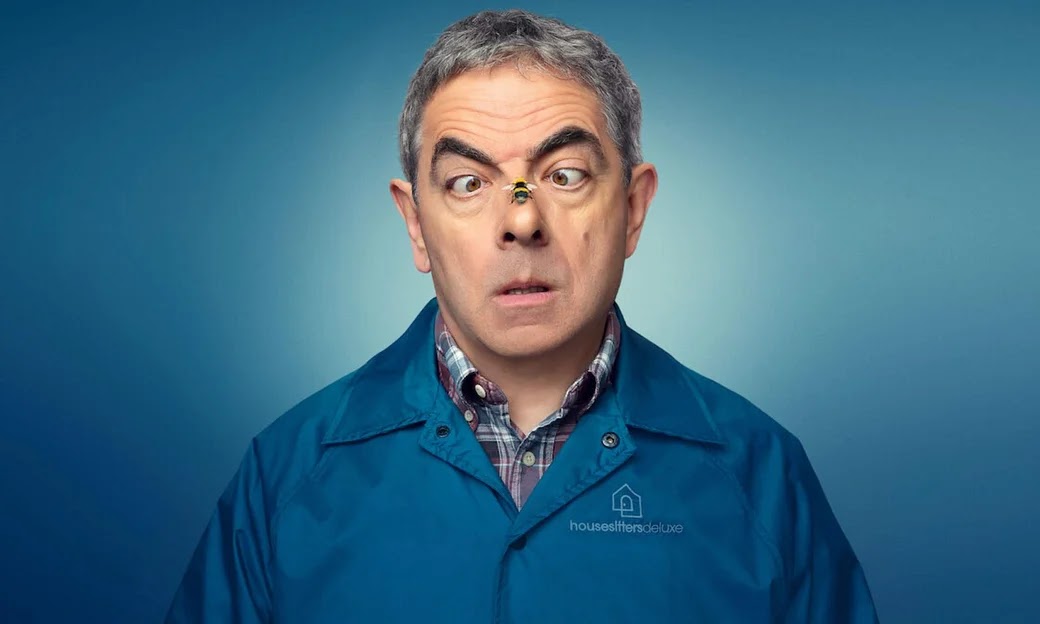
What if Mr. Bean was a sad sack single dad with a normal speaking voice? And what if a pesky, persistent bee invaded the high-tech mansion where he works as a housesitter?  Ponder those questions and you'll get a good idea of what you're in for here. Rowan Atkinson remains, at 67, a master of physical comedy, and there are a lot of laugh-out-loud moments in the first half.  But, thanks to unnecessary plot complications, the series runs out of gas well before its finale. (On a side note, I have NO idea why this was a series and not a movie; it's comprised of eight chapters, each of which clocks in at under 12 minutes, and each of which seamlessly segues, mid-scene, into the next.)

The Marvelous Mrs. Maisel (Amazon)

This series has repeatedly made a lot of noise about how much Midge Maisel will have to sacrifice to achieve stand-up comedy stardom. But we haven't actually seen her give up much.  Despite being fired from Shy Baldwin's tour and reduced to making jokes between strippers' acts in a burlesque house, Midge still gets to live in a swanky Upper West Side apartment, wear cute clothes and generally make everything about herself. Enough already!  I get that, in real life, it can take a performer many years to achieve their career goals. But we're four seasons into a five-season series, and our heroine doesn't seem to be anywhere near wised up.  And her stand-up still really isn't that funny, although the audiences she plays to seem to eat it all up.  

The best reason to watch this season?  The continuing friendship - and tantalizing chemistry - between Rachel Brosnahan's Midge and Luke Kirby's Lenny Bruce. The final episode feels like one we've waited years for..

Under the Banner of Heaven (Hulu)

A true crime series about the investigation of murders committed by a Fundamentalist Mormon cult.  Andrew Garfield gives a standout performance as the investigating detective who is himself a devout Mormon and whose faith is severely tested by what he finds.  It's well made, but the finer points of Mormonism that are key to the developing plot are often difficult to comprehend, let alone follow.  (Reading the recaps on Vulture, which are written by a ex-Mormon, will help.)

WeCrashed (Apple)

Yet another 'true scandal' drama, this one about the meteoric rise and spectacular fall of WeWork, a shared workspace concept that burned bright and fizzled fast thanks to the hubris and empty promises of its founder, Adam Neumann and his pretentious wife, Rebekah. Jared Leto, at his absolute Jared Leto-est, disappears entirely behind a thick Israeli accent and a constant stream of empty corporate-speak, while Anne Hathaway commits fully to Rebekah's narcissistic cluelessness. It's not that the story isn't compelling, nor that the series isn't competently made.  It's that Leto and Hathaway inhabit their characters so completely that they wind up being as annoying and grating as the real people must have been; a little of them goes a lo-o-o-ong way. Had the story been compressed into three or four episodes instead of eight, this might have ended up in the "Best" category.

DISAPPOINTMENTS

Anatomy of a Scandal (Netflix)

Good actors (Sienna Miller, Rupert Friend, Michelle Dockery) wasted in a mildly engrossing courtroom drama with an absolutely preposterous, completely unbelievable 'big reveal' at the end. I won't spoil it, in case you're still curious enough to watch. But don't say I didn't warn you.

The Flight Attendant (HBO Max)

Why on earth was a second season of The Flight Attendant deemed necessaryThe initial season was a well-crafted thriller with stylish and skillfully blended elements of suspense, comedy and pathos - and it was enjoyably complete in and of itself.  In season two, the title character (Kaley Cuoco)  has relocated to Los Angeles where she lives in a picture perfect bungalow and dates a nice, dependable guy while struggling to maintain her sobriety.  AA requires her to perform community service as part of her program, so she works as a civilian 'volunteer' for the CIA. Really? Does that even make sense?  The plot in this season is nearly incomprehensible. There's an entirely gratuitous and horrifying suicide scene along the way, and a lot of subplots that aren't particularly well integrated into the main story thread.  The only reason to watch is for Sharon Stone's chilling appearance as Cassie's weary, long-estranged mother.

Gaslit (Starz)

Bob Woodward and Carl Bernstein recently appeared on the Stephen Colbert show to talk about Watergate.  Bernstein recalled the day when Martha Mitchell called him up at the Washington Post to tell him that her husband, John (Nixon's attorney general) had left her and invited him to come over and go through her husband's diaries and papers. After consulting the Post legal department, he and Woodward did just that. They arrived to find Martha clutching a "birdbath-sized" martini and giving them access to a whole closet of Mitchell's papers. "We got some stories out of it," Bernstein recalled with a grin.

God, how I wish they'd put this incident in Gaslit

This series promotes itself heavily on the performance of Julia Roberts as the maligned Mrs. Mitchell. Even the title is a reference to how she was treated by Nixon's henchmen when she dared to tell the truth about Watergate.  And her performance is magnificent, as is Sean Penn's, playing John Mitchell under a shit ton of artfully applied latex and makeup.

But Martha's troubles are teased out in fits and starts, and only occasionally does she get to be the focus of the story. Far too much screen time is given to John and Maureen Dean (the former played by British actor Dan Stevens, affecting a just barely credible American accent.)  Stevens is bland and annoying, and although Dean clearly had a pivotal role in the scandal, Gaslit gets really boring every time the focus is on him. Every time I was forced to watch the newlywed Deans making out, I found myself wondering what Martha was up to. (There's also a lot of sensationalistic hoo-hah about G. Gordon Liddy, who really was more than a little nuts. But those were just more scenes I wanted to fast- forward through to get back to the Mitchells.)

Like the recent Hulu series, Mrs. America, this series about a major political event of the 1970s is written and directed by people who weren't even born (or, at best, were toddlers) when it took place. And it shows.  C_SPAN actually aired a far more engrossing docuseries on Watergate a few weeks later, in which the appearance of the real John Dean managed to be a highlight.

Ten Percent (Amazon. Sundance Now)


It must have seemed like a good idea to make an English language version of the popular French Netflix series Call My Agent, but this remake is nothing special.  The first few episodes, in fact, are just scrupulously faithful remakes of the French episodes, except transferred to a London talent agency and cast with British stars like Helena Bonham Carter and Dominic West.  Once they leave the French story lines behind, the show gets a little better, but it's still hard to care about any of the characters … with one notable exception in the show's only entirely original character, Simon Gould. Once a promising actor, his career was derailed by his heavy drinking and crippling anxiety. One of the older agents takes Simon under her wing to find him the kind of role he's always deserved. He's played by Tim McInnerny, my favorite British actor that hardly anyone in America knows. (He was Hugh Grant's best friend in Notting Hill and was briefly on Game of Thrones, among many other roles.) He's the best thing in Ten Percent.

The Thing About Pam (Peacock)

The thing about Renee Zellweger is that she's in a fat suit for the first few episodes, and her latex jowls are so unconvincing (on my UHD television anyway) that she looks more like Fat Bastard from the Austin Powers movies than a murderous housewife with a taste for Cherry Coke Big Gulps.  This is yet another true crime drama in which Zellweger portrays the sociopathic woman who murders her best friend and then just keeps getting into more trouble. I normally like Zellweger, but this is not a good role for her. Other good actors (among them, Judy Geer and Josh Duhamel) are wasted here, too.